
What every lubricant importer and distributor should understand before negotiating their next purchase
By Karan Mithe,
CEO, Mithe Exports
https://www.linkedin.com/in/karan-mithe-39476b252
If you import or distribute lubricants, you have probably asked your supplier this question recently:
“If crude oil has come down, why are lubricant prices still so high?”
It is a fair question.
In fact, I believe every serious lubricant buyer should be asking it.
But there is one important mistake behind the question:
We often compare the price of crude oil directly with the price of finished lubricant.
The two are connected — but they are not the same market.
As an exporter working with lubricant buyers and suppliers, I believe understanding that difference can help importers negotiate better prices, plan inventory more intelligently, and avoid comparing quotations that are not actually equivalent.
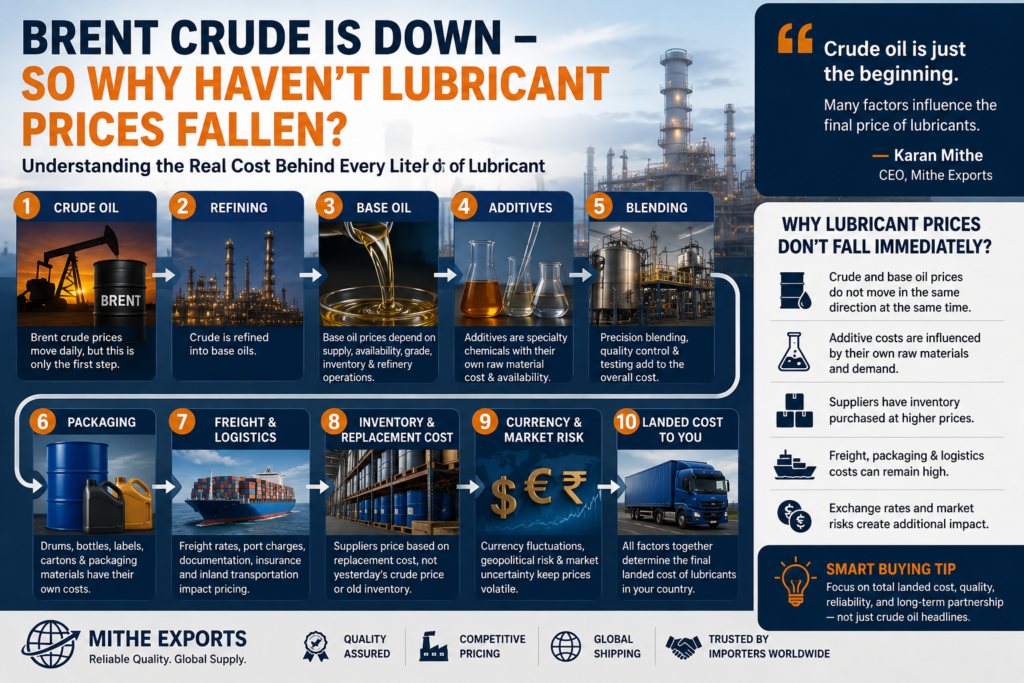
First: Crude Oil Is Not Lubricant
A finished lubricant is not simply crude oil put into a bottle.
The simplified chain looks like this:
Crude Oil → Refining → Base Oil → Additives → Blending → Packaging → Freight → Landed Cost
Every stage has its own supply-demand dynamics.
So when Brent crude falls, it does not automatically mean that the price of the lubricant sitting in a manufacturer’s warehouse should fall by the same percentage — or immediately.
This is where many price discussions between suppliers and buyers go wrong.
1. Base Oil Is More Important Than the Brent Chart
For many lubricants, base oil is a major component of the formulation.
And base oil does have a relationship with crude oil.
But the relationship is not one-to-one and not immediate.
Base-oil prices are also affected by:
- Refinery operating rates
- Base-oil production capacity
- Planned and unplanned shutdowns
- Availability of individual grades
- Regional supply and demand
- Inventory levels
- Import and export flows
- Freight
Recent market data provides a very good example.
In the U.S., base-oil producer prices increased sharply in May 2026 even while crude oil prices were declining. Analysts attributed part of the disconnect to the normal lag between crude and base-oil pricing as well as tighter availability of certain premium base oils.
That tells us something important:
Crude can move first. Base oil can move later. Finished lubricants can move after that.
The market does not operate like a switch.
2. Base Oil Supply Can Override the Crude Oil Effect
This is probably the most important point for an importer to understand.
Imagine crude oil falls.
You expect base oil to fall.
But at the same time, a major base-oil plant goes into maintenance, production is reduced, or a particular grade becomes difficult to source.
Suddenly, the base-oil market has its own supply problem.
The result?
Crude oil can be cheaper while the base oil required by a lubricant blender remains expensive.
This is not just theoretical. Industry commentary has specifically highlighted situations where crude declined but base-oil prices did not follow proportionately because demand-supply conditions and refinery maintenance were influencing individual grades.
That is why I would never evaluate a lubricant quotation using Brent alone.
3. Not All Lubricants Use the Same Base Oil
This is another area where buyers can accidentally compare apples with oranges.
Group I, Group II, Group III and synthetic base stocks have different characteristics and economics.
A premium engine oil requiring higher-performance base stocks cannot be compared directly with a conventional mineral formulation simply because both are labelled “engine oil.”
The same applies to two products carrying the same viscosity grade.
For example:
10W-40 does not automatically mean the two products have the same formulation.
The base oils, additive chemistry, performance level and specifications can be different.
So when comparing two suppliers, don’t ask only:
“Who is cheaper?”
Ask:
“What exactly am I getting for that price?”
That is a much more professional purchasing decision.
4. Additives Don’t Simply Follow Crude Oil
Base oil is only part of the formula.
Modern lubricants use additive packages to provide properties such as:
- Wear protection
- Oxidation resistance
- Detergency
- Corrosion protection
- Deposit control
- Viscosity control
- Low-temperature performance
These are specialized chemical components.
Their pricing depends on their own raw materials, manufacturing capacity, availability and supply-demand conditions.
So even if crude oil falls, the cost of an additive package may not fall at the same speed.
This is another reason why finished lubricant prices do not move one-for-one with Brent.
5. Then There Is Inventory
This is one of the most misunderstood parts of lubricant pricing.
Suppose a manufacturer purchased base oil when prices were high.
That base oil is still sitting in inventory.
Now Brent falls.
Should the manufacturer immediately reduce the price of every finished lubricant?
It may not be economically possible.
The manufacturer has already invested money in the raw material.
This is why you sometimes see a delay between a change in commodity prices and a change in finished-product prices.
The same principle applies to distributors.
If a distributor purchased 20,000 litres at a higher cost, he cannot suddenly replace the entire inventory at today’s lower theoretical market price.
He has to manage his actual inventory cost and replacement cost.
6. Freight Has Nothing to Do With Your Brent Chart
For an international importer, this becomes even more important.
Your final cost isn’t just the ex-factory lubricant price.
You may also be paying for:
- Inland transportation
- Port handling
- Documentation
- Container charges
- Ocean freight
- Insurance
- Destination charges
- Warehousing
- Financing
And international freight can change because of shipping routes, vessel availability, fuel costs and geopolitical risk.
So an importer in Tanzania, Kenya, Egypt or another African market should be looking at landed cost, not simply the Brent price.
7. Packaging Also Adds to the Cost
A lubricant doesn’t reach your customer as a barrel of crude.
It reaches them in:
- 1-litre bottles
- 5-litre packs
- 20-litre pails
- 26-litre packs
- 210-litre drums
- IBCs
- Customized private-label packaging
There are costs for containers, closures, labels, printing, cartons, pallets and handling.
If you are buying private-label products, customized packaging can add another layer of cost.
Again:
Brent can fall while your packaging cost remains unchanged.
8. Currency Can Eat Up the Reduction
International lubricant trading also involves currencies.
A supplier may buy certain materials in USD but pay manufacturing and operating expenses in INR.
An importer may purchase in USD but sell in Tanzanian shillings, Kenyan shillings, Egyptian pounds or another local currency.
Therefore, even when the underlying product cost moves in the buyer’s favour, exchange-rate movements can change the actual commercial benefit.
This is why an importer should evaluate the complete landed economics, not one commodity price.
9. Geopolitical Risk Can Keep the Market Unstable
There is another factor that buyers cannot ignore right now:
geopolitics.
Oil markets remain sensitive to disruptions around major production and shipping routes. On August 14, Brent rose to about $88.52/bbl amid renewed tanker attacks and heightened tensions involving Iran and shipping through the Strait of Hormuz.
The important point isn’t simply that oil went up.
It is that uncertainty itself has a cost.
When shipping routes become less predictable, companies may face:
- Higher freight risk
- Higher insurance costs
- Longer transit times
- Supply interruptions
- Higher inventory requirements
- More cautious purchasing
- Greater uncertainty around replacement cost
So even if crude temporarily moves lower, suppliers may remain cautious about cutting prices aggressively when they don’t know what their next shipment of raw material will cost.
So, When Should Lubricant Prices Actually Fall?
This is the question I would ask as a buyer.
My answer is:
Not when crude falls for a few days.
I would look for a broader and more sustained reduction across the supply chain.
For finished lubricant prices to come down meaningfully, we would ideally want to see:
- Base-oil prices declining
- Base-oil availability improving
- Additive costs stabilizing
- Refinery supply becoming more predictable
- Freight remaining stable or falling
- Packaging costs stabilizing
- Inventory purchased at lower replacement costs
- Currency conditions remaining favourable
- Geopolitical risk reducing
- Competition increasing between suppliers
That is when the argument for a meaningful reduction becomes much stronger.
What Should an Importer Ask His Supplier?
This is where I think buyers can become much smarter negotiators.
Instead of saying:
“Crude is down. Reduce your price.”
Ask these questions:
1. What base oil are you using?
2. Has your actual base-oil purchase price decreased?
3. What additive package is being used?
4. Are you pricing from existing inventory or replacement cost?
5. What is your current quotation validity?
6. What price can you offer at a higher volume?
7. If base-oil prices fall further, can we review the price again?
These questions force the discussion away from headlines and toward the real cost structure.
What I Would Do If I Were an Importer Today
I would not wait indefinitely for the perfect crude-oil price.
Instead, I would look at five numbers:
Current inventory
Monthly sales
Current landed cost
Supplier reliability
Expected replacement cost
Then I would decide how much to buy.
Because sometimes the best buying opportunity isn’t when crude reaches the lowest headline price.
It is when your supplier gives you a competitive landed cost with reliable supply and predictable replacement pricing.
My View as an Exporter
I understand why importers are pushing suppliers for lower prices.
And honestly, they should.
A buyer’s responsibility is to protect his margin.
But a supplier’s responsibility is also to explain the price honestly.
I don’t believe the right answer is:
“Crude is high, so lubricant prices are high.”
That is too simple.
The real answer is much more complicated.
The price of a finished lubricant is the result of several markets interacting with each other:
Crude Oil
↓
Base Oil
↓
Additives
↓
Blending
↓
Packaging
↓
Freight
↓
Inventory & Replacement Cost
↓
Geopolitical Risk
↓
Landed Cost
That is the chain I would look at before deciding whether a lubricant quotation is genuinely expensive.
One Final Thought for Importers & Distributors
If you are currently looking at the oil market and thinking:
“Crude has fallen. Why hasn’t my lubricant price fallen?”
You’re asking the right question.
But don’t stop at Brent.
Go one level deeper.
Ask what happened to the base oil.
Ask what happened to additives.
Ask about inventory.
Ask about freight.
Ask about replacement cost.
And most importantly, compare the actual product specification and landed cost, not just the supplier’s headline price
Because in international lubricant trading, the cheapest quotation is not necessarily the cheapest product.
The real objective is to secure the right specification, consistent quality, competitive landed cost and a supplier who can support your next order as well.
That is how I believe importers and exporters should approach lubricant pricing in today’s market.
About the Author
Karan Mithe https://www.linkedin.com/in/karan-mithe-39476b252/ is the CEO of Mithe Exports, an India-based manufacturing export and sourcing company working with international buyers across lubricants, greases and industrial products.
His work focuses on practical sourcing, export pricing, product specifications and building long-term B2B relationships between Indian suppliers and international importers and distributors.
Looking for lubricant supply from India?
Share your required product, viscosity grade, packaging and estimated quantity with the Mithe Exports team.Lubricants & Greases
Request a Lubricant Quote →