If you recently requested a quotation for lubricants or grease and noticed that the price is valid for only two, three, or four days instead of the usual 15 or 30 days, you are not imagining it.
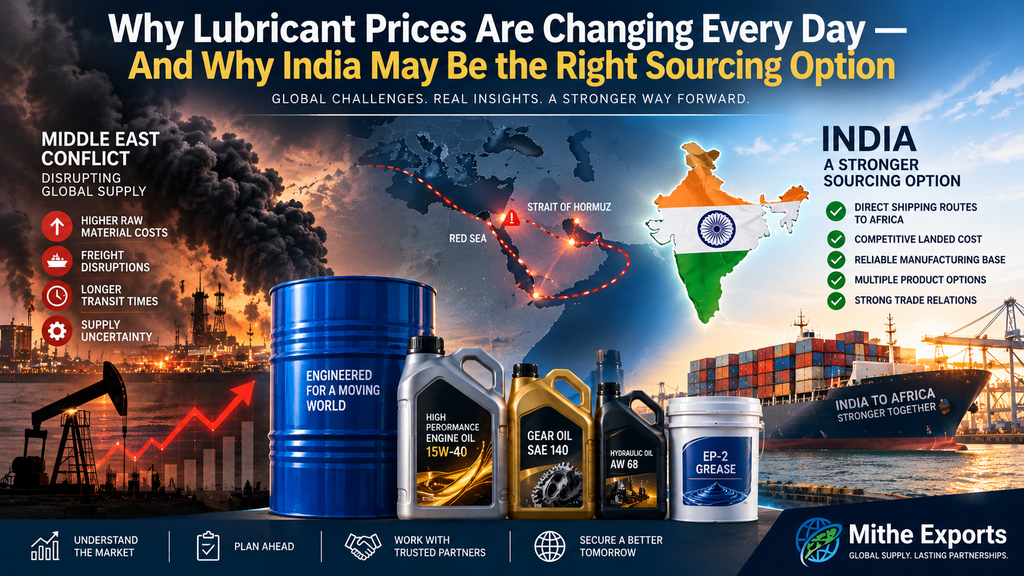
The global lubricant market is facing a period of serious uncertainty. Crude oil prices, base oil costs, additives, packaging, freight, insurance, currency movements, and shipping routes are all affecting the final price.
The ongoing conflict in the Middle East has added another layer of pressure. Important energy and shipping routes around the Gulf, the Strait of Hormuz, the Red Sea, and the Bab el-Mandeb region are facing disruption and uncertainty.
As a result, a supplier may offer a price today but may not be able to guarantee the same price next week.
This article explains why lubricant prices are changing so quickly, why Dubai and Gulf-based supply chains are facing additional challenges, and why India may be a practical sourcing option for African and other international buyers.
Why Are Lubricant Prices Changing Every Day?
Lubricants are not made from crude oil alone.
The final price depends on several materials and services, including:
- Base oil
- Additive packages
- Packaging materials
- Manufacturing costs
- Electricity and fuel
- Labour
- Inland transportation
- Port charges
- Ocean freight
- Marine insurance
- Currency exchange rates
When the cost of one or more of these inputs changes, the supplier’s final price may also change.
For example, a manufacturer may purchase base oil at one price today. However, when the same manufacturer needs to replenish its stock, the replacement material may cost more.
Therefore, the supplier must consider not only the cost of its existing stock but also the cost of replacing that stock.
This is one major reason why quotation validity has become shorter.
How the Middle East Conflict Is Affecting Lubricant Supply
The Middle East is an important part of the global energy and shipping system.
The Strait of Hormuz is a major route for oil and energy shipments. The Red Sea and Bab el-Mandeb are also important for trade between Asia, the Middle East, Europe, and Africa.
The ongoing conflict has created uncertainty around these routes. Vessels may need to change their routes, wait for updated instructions, or accept longer sailing times.
The International Energy Agency has described the war-related disruption around key Middle Eastern maritime chokepoints as a major risk to global oil supply and energy security. The agency is also monitoring changes in traffic through the Strait of Hormuz, the Red Sea, and other important routes.
The situation has affected more than crude oil. It can also influence:
- Base oil availability
- Refined petroleum products
- Additive transportation
- Vessel availability
- Freight rates
- War-risk insurance
- Port operations
- Delivery schedules
- Container availability
Therefore, even if a lubricant manufacturer in India, Dubai, or another country has stock available, the cost and timing of moving that product may still change.
Why Dubai and Gulf-Based Supply Chains Are Facing Pressure
Dubai and the wider Gulf region have traditionally been important trading and distribution centres.
Many international buyers source lubricants through the UAE because the region offers:
- Large trading networks
- Warehousing facilities
- Re-export services
- International banking support
- Access to Gulf-based suppliers
- Regional distribution connections
However, a trading hub is not separate from the risks affecting the surrounding region.
When conflict affects Gulf shipping routes, energy infrastructure, or regional vessel movement, the impact can reach companies that are buying through Dubai—even if the goods are not manufactured in Dubai.
A typical Gulf-based supply chain may look like this:
Manufacturer or base oil supplier → Gulf trading company → Dubai warehouse or port → Transshipment or ocean shipment → African destination
Each additional step can create another cost or delay.
For example, buyers may face:
- Higher freight charges
- Longer transit times
- Transshipment delays
- Limited vessel availability
- Higher insurance costs
- Delayed cargo collection
- Changes in export schedules
- Additional handling or storage charges
Recent shipping updates have also highlighted that the Middle East situation continues to affect cargo acceptance, routing options, port congestion, and delivery planning across connected trade lanes.
This does not mean that every Dubai supplier is unreliable. Dubai remains an important commercial centre.
However, buyers should not assume that a Gulf quotation automatically provides the safest or cheapest route in the current market.
Is Dubai Always More Expensive Than India?
No.
It would be incorrect to say that India is always cheaper than Dubai or that every Gulf supplier is facing the same level of difficulty.
The actual result depends on:
- Product type
- Product quantity
- Packaging
- Supplier location
- Port of loading
- Destination port
- Freight quotation
- Transshipment requirements
- Insurance
- Import duties
- Delivery schedule
- Payment terms
However, the current situation gives buyers a strong reason to compare India and the Gulf again.
A buyer who previously purchased through Dubai may now find that direct sourcing from India offers a simpler route for a particular destination.
The correct comparison is not only:
Price per litre or price per can
The correct comparison is:
Complete landed cost + delivery time + supply reliability
Why India May Be a Strong Sourcing Option Right Now
India has a broad manufacturing base and a large industrial supply ecosystem.
Indian companies produce and export several types of lubricants and industrial oils, including:
- Engine oils
- Hydraulic oils
- Gear oils
- Compressor oils
- Transformer oils
- Industrial lubricants
- Automotive lubricants
- Greases
- Specialty oils
India also has major ports and established trade connections with Africa, the Middle East, Southeast Asia, and other markets.
For many African buyers, a direct route may look like this:
Indian manufacturer → Indian port → African destination port
This route may reduce the need for an additional Gulf trading or transshipment step.
As a result, buyers may benefit from:
- Fewer supply-chain stages
- Direct communication with the manufacturer
- Better control over product specifications
- Easier packaging discussions
- Private-label support
- Clearer production planning
- More direct shipment coordination
- Potentially lower handling costs
However, these advantages must be confirmed for each shipment. Freight rates and vessel schedules can change, so buyers should always request a current shipping quotation.
India Is Not Completely Protected From Global Price Pressure
India is also connected to the global oil and energy market.
Indian manufacturers can face higher costs when:
- Imported crude becomes more expensive
- Base oil prices increase
- Additives become difficult to source
- Freight costs rise
- The Indian rupee moves against the US dollar
- Packaging materials become more expensive
- International supply becomes uncertain
Therefore, buyers should not expect Indian suppliers to remain completely unaffected by global events.
The important difference is not that India has no pricing pressure.
The important difference is how the supplier manages and explains that pressure.
A responsible manufacturer should explain:
- What is affecting the price
- How long the quotation can remain valid
- Whether the price includes freight
- Whether the product is available from stock
- How much production time is required
- Whether the price may change before dispatch
Transparency allows the buyer to plan properly.
Why Quotation Validity Has Become So Short
In a stable market, a supplier may be able to hold a price for 15, 30, or even 60 days.
In the current market, that may not be practical.
Suppose a supplier gives a quotation on Monday.
The buyer discusses it internally on Tuesday. The buyer compares other suppliers on Wednesday and returns on Friday to confirm the order.
During those few days, the supplier may face a change in:
- Base oil price
- Additive cost
- Packaging cost
- Freight
- Currency exchange rate
- Insurance
- Production availability
Therefore, the supplier may need to revise the quotation.
This does not automatically mean that the supplier is trying to pressure the buyer.
In many cases, the supplier is trying to avoid accepting an order that may become commercially unworkable.
A short quotation validity period should be explained clearly. It should not be hidden from the buyer.
The Buying Approach That May No Longer Work
Many buyers follow this traditional process:
- Request a quotation.
- Wait for several weeks.
- Ask for another discount.
- Compare the old quotation with new quotations.
- Return to the original supplier.
- Expect the original price to remain unchanged.
This process may have worked in a more stable market.
However, when prices are changing quickly, waiting can create additional risk.
The buyer may lose:
- The original price
- Available stock
- A production slot
- A vessel booking
- A delivery window
- The opportunity to replenish inventory on time
This does not mean that buyers should stop negotiating.
Negotiation remains an important part of international trade.
However, buyers should distinguish between:
Negotiating carefully within the quotation validity period
and
Delaying the decision until the market changes
The second approach may create more cost than the discount the buyer hoped to receive.
Speed Is Important, But Verification Comes First
Being fast does not mean buying from an unknown supplier without checking the details.
Before confirming an order, buyers should verify:
- Company information
- Product specification
- Manufacturer details
- Technical Data Sheet
- Safety Data Sheet
- Certificate of Analysis
- Packaging quality
- Payment terms
- Export documents
- Shipping terms
- Product samples, where required
After the supplier has been properly verified, the buyer should be ready to make a timely commercial decision.
In the current market, speed can be a competitive advantage.
However, speed without proper verification can create a different type of risk.
The correct approach is:
Verify carefully. Decide clearly. Act within the agreed validity period.
What Should Buyers Do If They Are Running Low on Stock?
If your stock is already low, do not wait until your warehouse is empty before contacting suppliers.
Start by reviewing:
- Current stock
- Monthly consumption
- Average sales
- Expected demand
- Production time
- Shipping time
- Customs clearance time
- Safety stock
- Cash-flow availability
For example, if your complete supply cycle takes 60 to 90 days, you should begin planning before your stock reaches a critical level.
In a volatile market, early planning gives you more choices.
You can compare India and Dubai.
You can review different suppliers.
You can negotiate the quantity.
You can check freight.
You can arrange payment.
You can also avoid emergency purchasing at an unfavourable price.
India vs. Dubai: What Should Buyers Compare?
International buyers should compare both options using the same commercial information.
| Factor | Sourcing From India | Sourcing Through Dubai or the Gulf |
|---|---|---|
| Supply model | Direct manufacturer or exporter | Manufacturer, trader, warehouse, or re-exporter |
| Route | May allow direct shipment from an Indian port | May involve Gulf handling or transshipment |
| Product control | Direct discussion with the manufacturer may be possible | Product may pass through an additional trading layer |
| Packaging | Private-label and bulk packaging can be discussed directly | Depends on the supplier and warehouse arrangement |
| Freight | Must be checked for the exact Indian port and destination | Must include possible handling, transshipment, and regional disruptions |
| Lead time | Includes production plus ocean transit | Includes sourcing, handling, possible transshipment, and ocean transit |
| Price | Linked to Indian raw material and production costs | May include trading, warehousing, handling, and re-export costs |
| Communication | Buyer may communicate directly with the manufacturing team | Buyer may communicate mainly with a trading company |
| Risk | Indian suppliers are also exposed to global oil and freight changes | Gulf routes are exposed to regional shipping and security conditions |
This table is not a permanent rule.
A particular Dubai supplier may offer a better price or faster service than an Indian supplier. Likewise, a particular Indian supplier may have higher freight or longer production time.
Therefore, buyers should compare actual quotations rather than rely only on general assumptions.
A Practical Roadmap for Buying Lubricants From India
Step 1: Confirm Your Requirement
Prepare a clear list of:
- Product names
- Product grades
- Packaging sizes
- Required quantities
- Destination port
- Brand requirements
- Private-label requirements
Step 2: Shortlist Suitable Suppliers
Find suppliers who can provide the required product, quality documents, packaging, and export support.
Step 3: Verify the Supplier
Check the company, manufacturing arrangement, documents, samples, and previous export experience.
Step 4: Request a Current Quotation
Ask the supplier to mention:
- Unit price
- Total value
- Packaging
- Incoterm
- Port of loading
- Production time
- Payment terms
- Quotation validity
Step 5: Ask Why the Price Is Valid for Only a Few Days
A transparent supplier should be able to explain whether the price is affected by:
- Base oil
- Additives
- Freight
- Currency
- Packaging
- Stock availability
- Replacement cost
Step 6: Compare India With Dubai
Request current quotations from both routes.
Compare the full landed cost, not only the product price.
Step 7: Confirm the Freight
Ask your freight forwarder or supplier for the latest freight quotation.
Confirm whether the price includes:
- Ocean freight
- Terminal charges
- Documentation
- Security surcharges
- War-risk charges, where applicable
- Insurance
- Other origin or destination costs
Step 8: Make an Internal Decision Quickly
Once the supplier has been verified and the quotation is commercially workable, complete your internal approval process without unnecessary delay.
Step 9: Confirm the Purchase Order
The purchase order should clearly mention:
- Product specification
- Quantity
- Packaging
- Price
- Payment terms
- Delivery terms
- Production schedule
- Quality requirements
- Required documents
Step 10: Plan the Next Order Early
Do not wait until the current stock is finished.
A good distributor plans the next shipment before the stock position becomes critical.
Questions Buyers Should Ask Their Supplier
Before confirming an order, ask the following questions:
- How long is this quotation valid?
- What is the main reason for the short validity?
- Is the product available from stock?
- How many days are required for production?
- What is the current freight to my destination?
- Are there any additional charges?
- Can you provide a TDS, SDS, and COA?
- Can you support private-label packaging?
- What payment terms are available?
- What happens if raw material prices change before production?
- When can the goods be dispatched?
- How will shipment updates be shared?
These questions can help buyers avoid confusion later.
The Importance of Trust Between Buyer and Supplier
The current market requires understanding from both sides.
Buyers want stable prices, reliable quality, and timely delivery.
Suppliers want confirmed orders, realistic quantities, and protection against sudden cost increases.
Both expectations are reasonable.
A supplier should not change a price without explanation. At the same time, a buyer should understand that a quotation made several days ago may no longer reflect the supplier’s current cost.
The best business relationships are built through:
- Clear communication
- Honest pricing
- Accurate documents
- Realistic timelines
- Proper quality control
- Timely decisions
- Mutual respect
A buyer does not need to accept every price.
A supplier does not need to accept every demand.
However, both sides should communicate openly and work toward terms that are commercially practical.
My Message to Buyers Looking for Lubricants From India
If you are an importer or distributor looking for lubricants or grease, especially for African markets, India is worth evaluating carefully at this time.
India may offer advantages through:
- Direct manufacturer communication
- Established export infrastructure
- Product and packaging flexibility
- Industrial manufacturing capacity
- Direct shipping options to selected African destinations
- Private-label opportunities
- Potentially fewer trading layers
However, the final decision should always be based on the actual product, supplier, destination, freight, and landed cost.
Do not choose India only because someone says it is cheaper.
Do not choose Dubai only because it was your usual sourcing route.
Instead, compare both options using current information.
Ask questions.
Check the documents.
Confirm the freight.
Understand the quotation validity.
Then make a decision based on your stock position, cash flow, customer demand, and delivery requirements.
Final Thoughts
The global lubricant market is changing quickly.
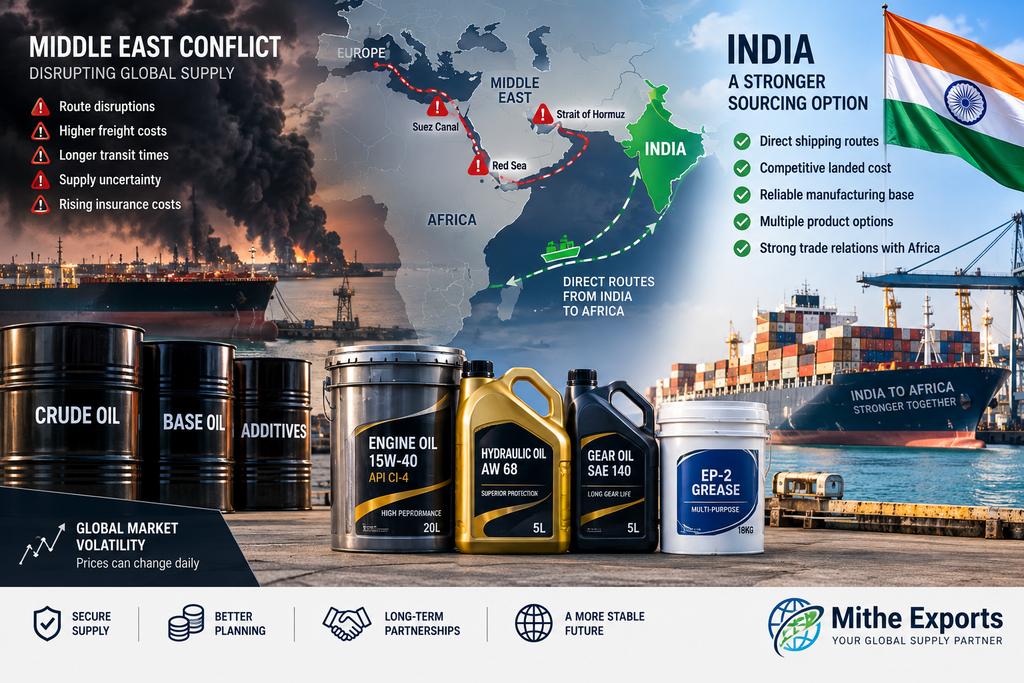
The Middle East conflict has created pressure across energy supply, shipping routes, freight, insurance, and delivery planning. These effects can reach manufacturers, trading companies, distributors, and final buyers.
Dubai and the Gulf remain important commercial centres. However, buyers should carefully review the additional risks and costs connected with Gulf-based supply chains.
At the same time, India is also affected by global raw material and freight movements. India is not isolated from the international market.
The advantage of India may come from direct manufacturing access, established export infrastructure, flexible packaging, and the possibility of shipping directly to selected destinations.
The most important lesson is this:
Do not compare only the price on the quotation. Compare the complete landed cost, supply reliability, product quality, and delivery time.
In a volatile market, the lowest price is not always the best commercial result.
Sometimes, the most valuable price is the price you can actually secure, manufacture, ship, and receive on time.
About the Author
Karan Mithe is the CEO of Mithe Exports, an India-based export and Manufaturing company working with international buyers across lubricants, greases, industrial products, and other product categories.https://www.linkedin.com/in/karan-mithe-39476b252/
Through Mithe Exports, Karan focuses on transparent communication, practical sourcing, export planning, and long-term business relationships.Contact Us